Build a landing page and a flow together
A funnel is a landing page and a conversational form generated as a matching pair, with every button on the page already wired into the flow.
You’ll need: An account with enough credits for both halves.
A landing page sells. A conversational form collects. Built separately, you then have to wire them to each other and keep them saying the same thing.
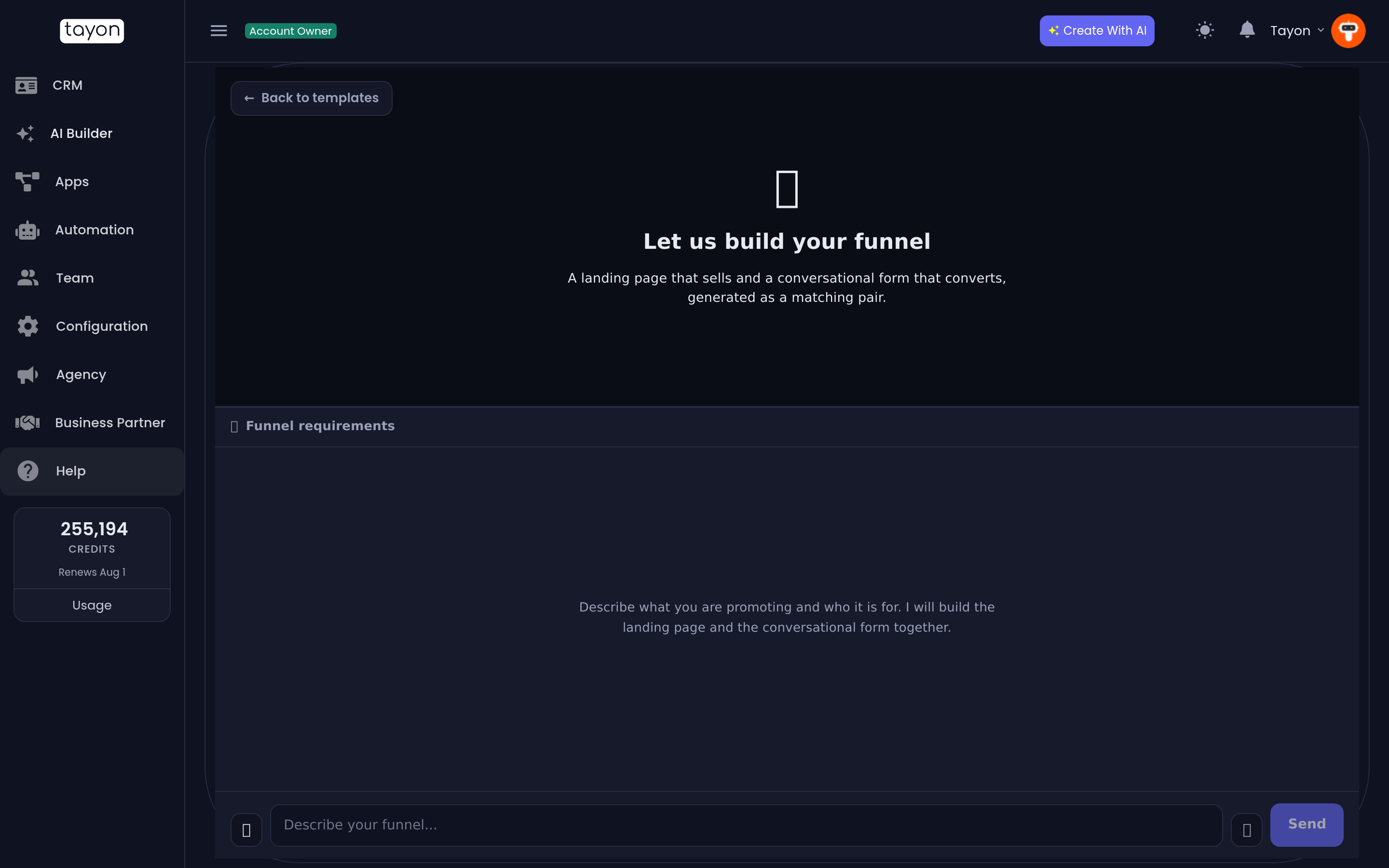
A funnel builds both from one description: “A landing page that sells and a conversational form that converts, generated as a matching pair.”
#Start one
A funnel is not something you tick on the start screen. It is a ready-made pairing, so you start it from the gallery:
- Open the template gallery.
- Pick a card from the Funnels section.
There are four cards:
| Card | What it is for |
|---|---|
| Offer & Promo | A page that sells your offer and a flow that captures the buyer. |
| Event & Webinar | An event page plus a registration flow that fills the room. |
| Lead Magnet | Give away a guide, keep the contact. |
| Consultation Booking | A page that builds trust and a flow that books only good fits. |
Each shapes the flow half differently. Lead Magnet, for instance, hands the download over on the last screen of the flow rather than promising to email it.
#A funnel or a set?
Ticking Website and Conversational Form together on the start screen gets you the same two things, wired the same way. The difference is what happens when something goes wrong, and it is deliberate:
| If the form fails | |
|---|---|
| Funnel | The whole thing is abandoned. A landing page whose buttons lead nowhere is worse than nothing |
| A set built together | The half that worked is kept, and you keep it |
So pick a funnel when the page is worthless without the flow, and a set when the pieces stand on their own. See Build everything at once.
#Describe it
The builder opens on Let us build your funnel with a Funnel requirements panel: “Describe what you are promoting and who it is for.”
That sentence is the whole brief. Both halves are written from it, so say:
- What you are promoting — the offer, the event, the guide, the service.
- Who it is for — the audience, in plain words.
- What makes someone say yes — the price, the date, the promise, the proof.
You do not need to describe the page and the flow separately. They are deliberately written to complement each other: the landing page does the selling, and the flow does not repeat the pitch.
#Generate it
When the panel reads Ready to build your funnel, choose Build my funnel.
The conversational form is built first, then the landing page is designed around its link — that ordering is what lets every button on the page point at a flow that already exists.
Progress runs through Getting started…, Building the conversational form…, Designing the landing page…. It takes a few minutes, and you can leave the page — it keeps running.
When it finishes you get Your funnel is ready, with both halves side by side: Landing page and Conversational form, each with its link and an edit button — Edit page opens the Website Editor, Edit flow opens the Flow Designer.
#What “paired” actually means
Every call-to-action on the landing page sends the visitor into the conversational form, and every lead the flow captures lands in your CRM. You do not have to connect anything.
After that they are two ordinary projects and you edit them independently. A change to the page does not rewrite the flow, and vice versa.
#Three entries in your project list
A funnel appears in Your Projects as three cards: the funnel itself, plus the landing page and the conversational form it produced. The two children are marked as generated as part of the funnel, so you can tell them from projects you started on their own.
That is deliberate — it is what lets each half open in its normal editor and be managed like anything else. See Manage your projects.
#Publishing
The conversational form is published as part of generation and its link works immediately. The landing page follows the ordinary rules for a website — it is a draft until you publish it, and a published site costs credits per day. See Publish your website.
#If half of it fails
The two halves fail differently, on purpose:
| What failed | What you see | What it costs |
|---|---|---|
| The conversational form | The funnel could not be built | Nothing was charged for the landing page — it was never started. Try again re-runs the whole thing. |
| The landing page | The landing page could not be built | Your conversational form is live and already paid for. Retry the landing page rebuilds only that half. |
Retrying the page alone is the point of splitting them: regenerating both would bill you for the flow twice.
Nothing retries itself. If a build stalls, the screen tells you and waits for you to decide.
#Starting another
New funnel begins a fresh conversation. The one you have stays exactly as it is, in your project list, with both halves intact.
Updated: